
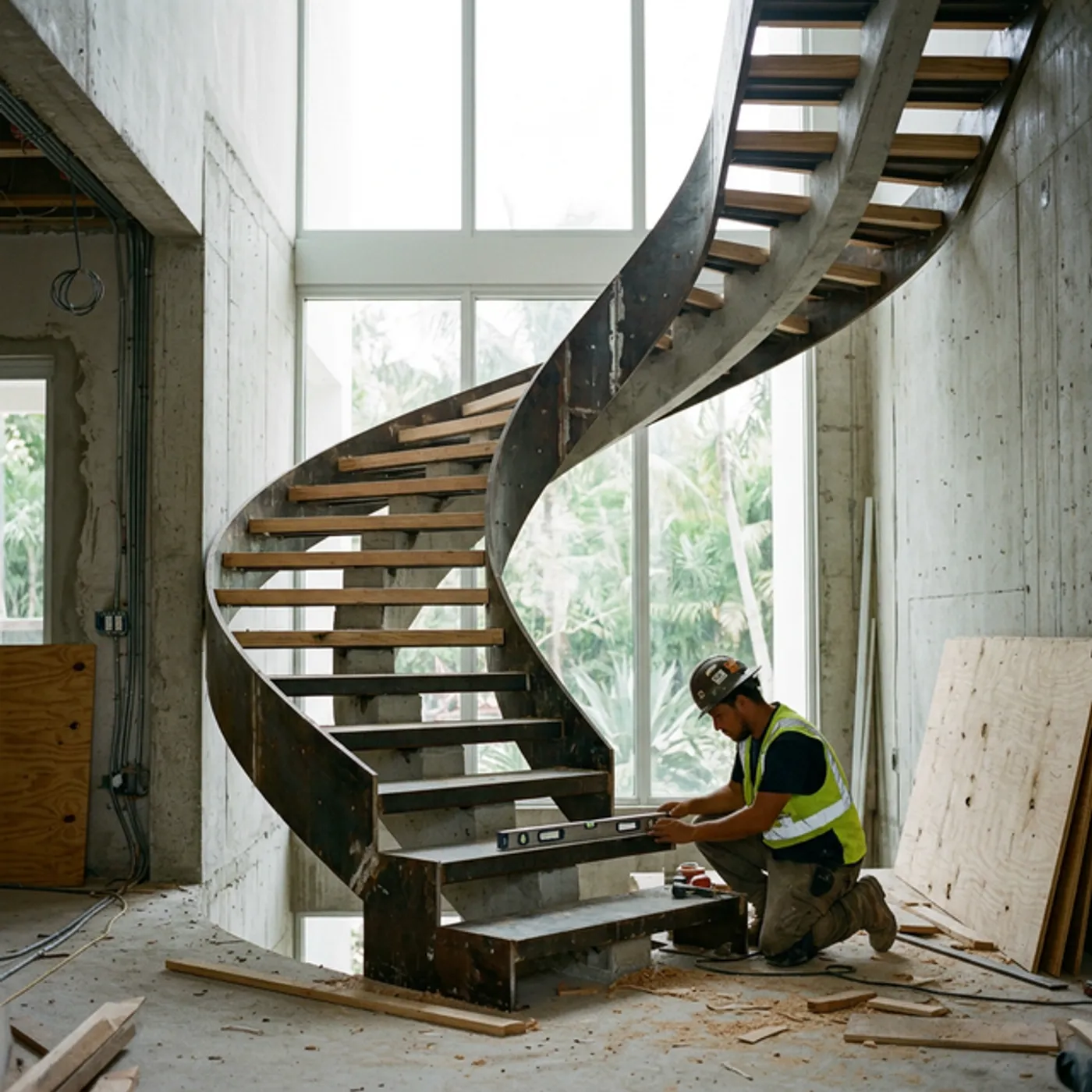
Curved Cantilevered Staircase Design in Toronto, ON
Custom curved and helical floating stair systems for Toronto homes where geometry becomes the centrepiece. Engineered to OBC standards. Fabricated to exact field measurements.
Toronto Floating Stairs engineers and builds curved cantilevered floating staircases for Toronto homes and commercial spaces where a standard straight stair would underdeliver on the architecture.
Curved floating stairs are fundamentally more complex than straight systems. The stringer — if visible — must be formed or cut to a consistent radius. The treads must be tapered or fanned to maintain a uniform nose-to-nose rise while accommodating the changing plan geometry. The wall interface changes continuously, so each anchor bracket position requires individual calculation.
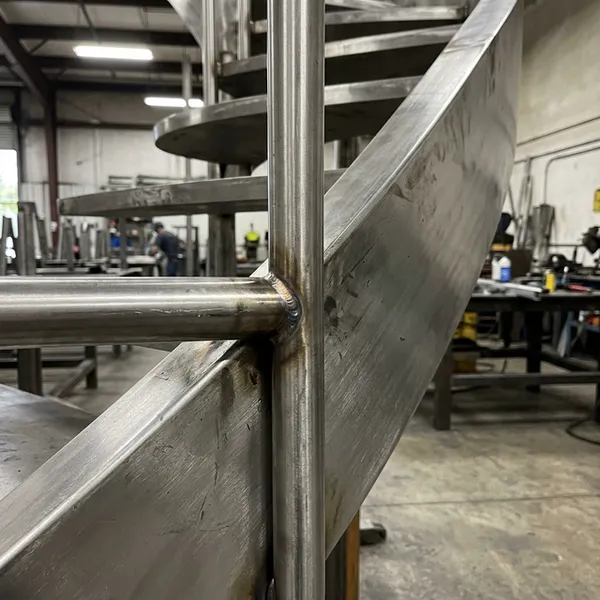
Most curved stair contractors in Toronto avoid cantilevered curved systems because the engineering is genuinely difficult. Standard stringer-and-bracket systems can't be adapted to a curved layout without serious compromises. We build curved floating stairs with properly engineered curved spine stringers — formed steel plate bent to radius — combined with individually positioned tread brackets calculated for each step position.
The result is a stair that reads as a continuous sculptural curve from every angle, not a series of approximated straight segments. That difference is visible and it's why clients who care about architecture seek this type of installation over a modified standard system.
We also build helical (full spiral) floating stair systems for spaces with sufficient ceiling clearance and structural wall capacity. Helical systems require more complex engineering and longer fabrication timelines, but they're achievable in the right Toronto property.
Curved staircase geometry options
Quarter-turn curved stairs (90° sweep) are the most common in Toronto residential projects — they fit naturally into corner entries and transition between floors with a smooth quarter-circle plan. Half-turn (180°) and three-quarter-turn systems are used in larger entry halls and commercial lobbies. Full helical systems are rare and require specific structural conditions, but we've delivered them in the GTA for clients who needed that level of architectural statement.
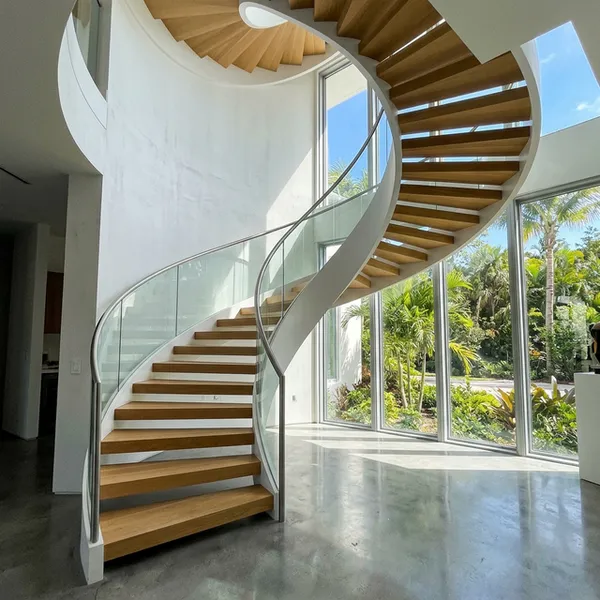
Design a curved stair for your Toronto space
Free site visit. We assess the space, take precise measurements, and model the curved geometry before fabrication begins.
- ✓ Quarter-turn curved stairs
- ✓ Half-turn curved stairs
- ✓ Helical / full spiral systems
- ✓ Custom radius geometry
- ✓ OBC-compliant engineering
How We Deliver a Curved Floating Stair
Frequently Asked Questions
How much more expensive is a curved floating stair than a straight one? +
Can a curved floating stair be installed in an existing Toronto home? +
How long does a curved floating stair project take? +
Can curved staircases have glass railings? +
Do you use 3D modelling for curved stair design? +
Ready to design a curved floating stair in Toronto?
Free site assessment. 3D geometry modelled before any fabrication commitment.